
More Leads Won’t Fix a Broken Sales Process
You’re getting leads.
People are filling out forms. They’re clicking your ads. They’re asking questions. They’re showing interest in your services.
But they aren’t booking.
So naturally, the conversation turns to marketing.
We need more leads.
Or better leads.
Maybe we need to increase the ad budget. Change the campaign. Try Google instead of Meta. Hire a different agency. Create a better offer.
And sometimes, marketing really is the problem.
But sometimes?
You don’t have a lead problem at all. You have a sales process problem.
And generating more leads won’t fix it.
It will simply send more opportunities into the same system that is already losing them.
Lead Generation and Lead Conversion Are Not the Same Thing
This distinction matters.
Marketing creates awareness and generates interest.
Sales converts that interest into revenue.
Your systems and CRM connect the two.
When those pieces work together, growth becomes much more predictable. When they don’t, businesses tend to focus on the easiest number to see: how many leads came in.
But lead volume tells you very little by itself.
You can generate 50 leads and close 20 of them.
You can generate 500 leads and close 10.
Which campaign would you rather have?
Exactly.
The goal isn’t simply to generate leads.
The goal is to create customers.
That means we have to pay attention to what happens after someone raises their hand.

Before You Blame the Leads
One of the easiest things to say when sales are slow is:
“These leads aren’t good.”
Maybe.
But before you decide the leads are the problem, take a closer look at what happened to them.
Pull the leads from the last 30 to 60 days and ask:
How quickly was each lead contacted?
How many received an actual personal response?
How many responded to your outreach?
How many had a real conversation with someone?
How many received more than one follow-up attempt?
How many were asked questions about what they were looking for?
How many booked?
How many showed up?
How many purchased?
How many simply stopped hearing from you?
Those answers tell you far more about the health of your sales process than the number of leads sitting in your CRM.
Because “the leads suck” isn’t a metric.
And unfortunately, it’s also not particularly useful.
Speed Matters More Than Most Businesses Realize
Think about what happens when someone fills out a form.
They’re interested right now.
Maybe they’re comparing IV therapy locations.
Maybe they’re looking for a med spa treatment.
Maybe they’re considering a wellness membership, weight loss program, consultation, or another service.
Whatever brought them to you, there is a moment when their interest is at its highest.
And then the clock starts.
If your team responds quickly, the conversation continues while that interest is still fresh.
If they respond six hours later, tomorrow, or whenever someone happens to check the inbox, that person may already be talking to someone else.
This is one of the places automation can make an enormous difference.
An immediate automated response can acknowledge the inquiry, start the conversation, provide the next step, and alert your team that someone needs attention.
But notice what I said.
Start the conversation.
Automation shouldn’t become an excuse to remove humans from the sales process.
Its job is to make sure the opportunity doesn’t disappear before a human has the chance to step in.
Sending a Price Is Not a Sales Conversation
This one happens constantly.
A lead asks:
“How much is it?”
And someone immediately sends the price.
Technically, the question was answered.
Mission accomplished, I suppose.
Except the person still hasn’t booked.
Price questions are often the beginning of a buying conversation, not the end of one.
Instead of simply responding with a number, your team has an opportunity to learn something.
What are they interested in?
Have they done this before?
What are they hoping to accomplish?
Are they comparing services?
Do they have questions or concerns?
What prompted them to reach out today?
You don’t need to interrogate someone like they’re applying for a mortgage.
You just need to have a conversation.
When your team understands what someone actually wants, they can guide them toward the appropriate next step instead of tossing a price into a text message and hoping the lead magically converts themselves.
One Follow-Up Is Not a Follow-Up Strategy
This might be one of the biggest leaks I see.
A lead comes in.
Someone sends a text.
The lead doesn’t respond.
And that’s it.
The lead gets labeled unresponsive and everyone moves on.
But people don’t live inside your CRM.
They’re working. Driving. Picking up kids. Sitting in meetings. Opening a text while standing in a grocery store and completely forgetting about it three minutes later.
Silence does not always mean no.
Sometimes it means not right now.
A good follow-up process accounts for that.
That might include a combination of:
Text messages
Emails
Phone calls
Voicemail drops
Staff follow-up tasks
Appointment reminders
Longer-term nurture
Periodic promotional communication
The goal isn’t to bombard people until they surrender and book an appointment just to make the messages stop.
The goal is to stay present long enough to give interested people a reasonable opportunity to respond.
There’s a difference.
Your Team Can Know the Service and Still Struggle to Sell It
This is especially common in wellness businesses.
You can have an incredibly knowledgeable team.
They may understand every treatment, membership, peptide, package, and/or service you offer.
That doesn’t automatically mean they know how to sell.
And selling doesn’t mean becoming pushy.
Good sales conversations are usually the opposite.
They’re about listening.
Asking better questions.
Understanding what someone needs.
Explaining the right solution clearly.
Handling hesitation without becoming defensive.
And confidently asking for the next step.
If your staff is uncomfortable doing that, more leads won’t solve the problem.
You’ll simply give an uncomfortable sales process more people to practice on.
Sales training matters because your CRM can create opportunities, but your people still have to know what to do when those opportunities appear.
Automation Should Support Your Sales Team, Not Replace It
This is where businesses can swing too far in the other direction.
They realize follow-up is inconsistent, so they automate everything.
Now every lead receives 14 texts, seven emails, three reminders, a birthday message, and possibly a carrier pigeon.
Technically, nobody was forgotten.
But that doesn’t necessarily mean the sales process improved.
Good automation creates consistency.
It can make sure:
New leads receive an immediate response.
Follow-up happens when staff gets busy.
Team members know when personal outreach is needed.
Missed calls don’t disappear.
No-shows receive another opportunity to book.
Leads who aren’t ready today stay connected over time.
Past clients aren’t forgotten.
Conversations and activity are visible in one place.
The best systems know when automation should do the work and when a person should step in.
That balance matters.
Because ultimately, people buy from people.
Your CRM should make those conversations easier to have ~ Nuvana does this 😉
The Leads Sitting in Your CRM Have Value
Businesses spend an incredible amount of time thinking about the next campaign.
Meanwhile, there may be hundreds or thousands of dollars in opportunities already sitting inside the CRM.
Cold leads.
People who asked about a service but never booked.
No-shows.
First-time clients who never returned.
People who responded to a campaign but didn’t purchase.
Prospects who said, “Maybe next month.”
People who were interested but weren’t ready yet.
Those aren’t necessarily dead leads.
Some of them are simply unfinished conversations.
Before increasing your marketing budget, look at the opportunities you already paid to generate.
There may be far more revenue sitting there than you realize.
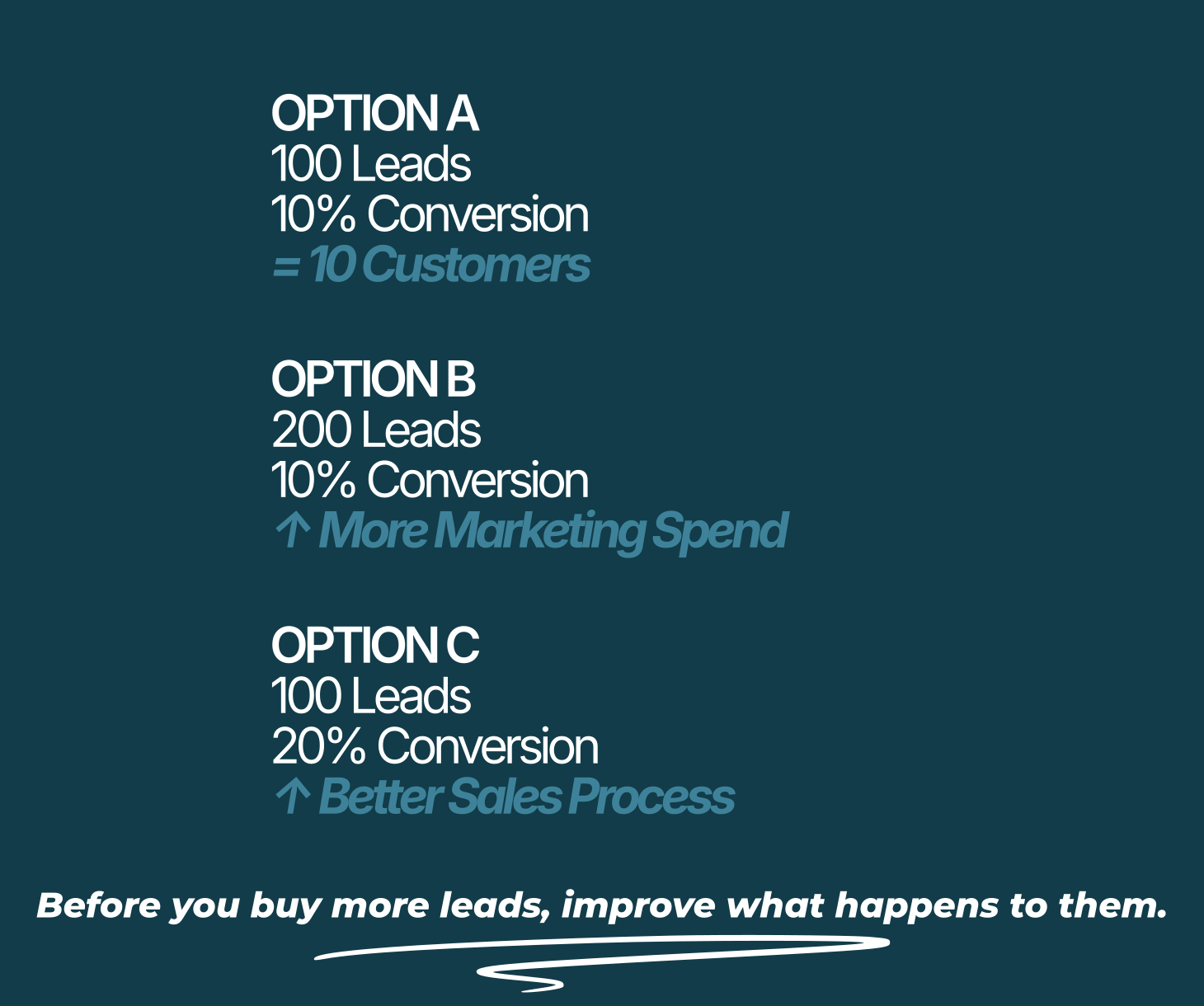
The Math Gets Expensive Fast
Let’s make this simple.
Imagine you generate 100 leads per month and convert 10% of them.
That gives you 10 customers.
If you want 20 customers, one solution is to double your lead generation.
Now you need 200 leads.
And assuming your cost per lead stays the same, you just doubled your lead-generation expense.
But what happens if you improve your sales process instead?
If those same 100 leads convert at 20%, you get 20 customers without doubling your lead volume.
Real life is obviously more complicated than a neat little example. Lead quality, service mix, pricing, show rates, capacity, and dozens of other variables matter.
But the principle is important.
Improving conversion can be just as powerful as increasing lead volume.
And often, it should happen first.
Otherwise, you’re paying to pour more water into a bucket that already has holes in it.
Your CRM Should Tell You Where the Problem Is
A CRM shouldn’t just be an expensive address book.
It should help you understand what is happening inside your sales process.
How many new leads came in?
Where did they come from?
How quickly were they contacted?
How many responded?
Where are conversations stalling?
How many appointments were booked?
How many people showed?
How many converted?
How many opportunities are still open?
How many were lost, and why?
Without visibility into those numbers, businesses start making decisions based on feelings.
Marketing feels slow.
The leads feel bad.
The staff feels busy.
Sales feel inconsistent.
None of those things tell you what is actually broken.
Data does.
Once you can see where leads are falling out of the process, you can start fixing the right problem.
Marketing Cannot Fix What Happens After the Lead Arrives
Marketing absolutely matters.
Your message matters.
Your offer matters.
Your targeting matters.
Your website matters.
Your reputation matters.
Your advertising strategy matters.
But marketing has a boundary.
At some point, the lead enters your business.
And then your process takes over.
If inquiries sit unanswered, marketing can’t fix that.
If staff doesn’t follow up, marketing can’t fix that.
If every salesperson handles leads differently, marketing can’t fix that.
If nobody knows why prospects aren’t booking, marketing can’t fix that.
If leads disappear into spreadsheets, inboxes, sticky notes, personal cell phones, and half-finished conversations, marketing definitely can’t fix that.
At some point, you have to stop asking:
"How do we get more leads?"
And start asking:
"What are we doing with the leads we already have?"
Fix the Process Before You Turn Up the Volume
More leads can absolutely grow your business.
But only when you have a system capable of converting them.
Before increasing your ad spend or launching another campaign, make sure the foundation is there.
Your leads should receive a quick response.
Your team should know how to have the conversation.
Your follow-up should be consistent.
Automation should prevent opportunities from slipping through the cracks.
Your CRM should show you exactly where each lead stands.
Your staff should know when they need to step in.
And your data should tell you where the sales process is working and where it isn’t.
Then?
Turn up the marketing.
Because now you’re sending more opportunities into a system designed to actually do something with them.
You may discover you don’t need more leads at all.
You may simply need to stop losing the ones you’ve already paid for.